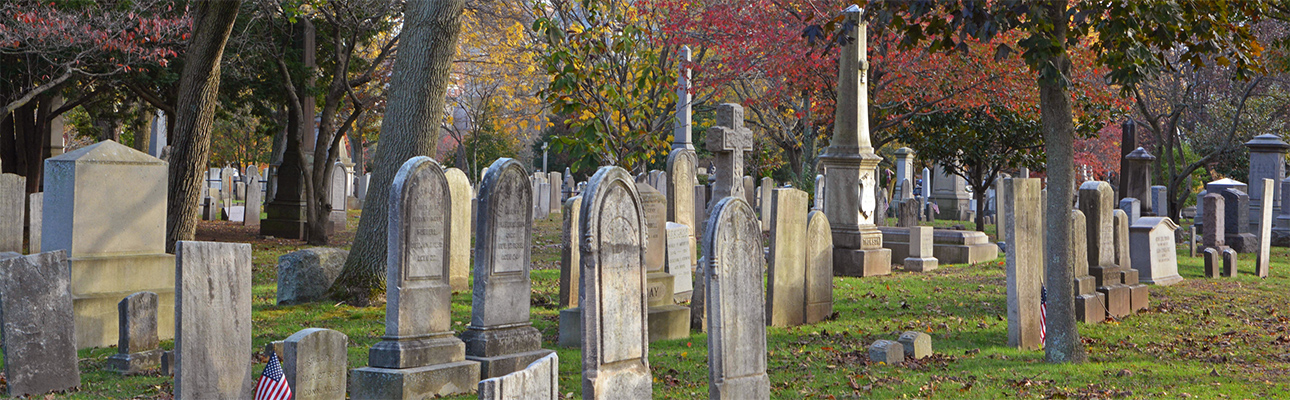

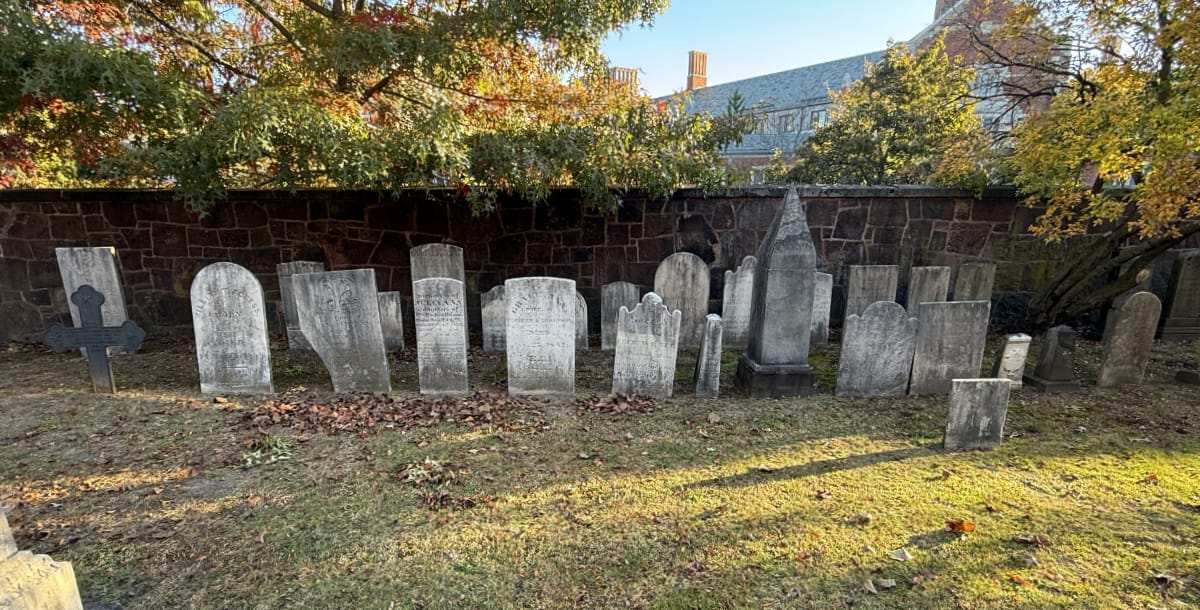
Research has determined that as space for burials in the New Haven City Burial Ground (Grove Street Cemetery) became again limited at the end of the nineteenth century only this time with no room to expand the grounds, the cemetery’s leadership confronted the challenge of how to manage the limited space while continuing to operate, as the sale of lots and burial fees were their main source of income. Their decision led to the disinterment and reburial of over 300 individuals, between the years of 1897–1901, which allowed for the resurvey and sale of additional family lots. Of those who research indicates were moved, about half were children, two-thirds were Black, and one-third were white, and most likely did not have gravestones. These remains were removed from sections designated as the “Strangers,” “People of Color,” and “Potter’s Field” lots on the map of 1800, which had by 1822 been moved to the north-west corner of the expanded grounds when the six “City Squares” managed by the City of New Haven were laid out (see the Historical Maps posted on our website). In the 1897–1901 transfer, remains and gravestones were assigned to new areas including a strip of land along the north wall which had previously been reserved for landscaping.
In January 1897, the cemetery superintendent and secretary of the Standing Committee, Edward Beecher, proposed this removal as a “radical move in the way of improvements.” A statement in the minutes of the Standing Committee of Proprietors notes, “Be it remembered that the lots and parts of lots in the north westerly section of the burying ground … belong to the common burying ground. Whoever may have taken of said lots have no title, they have no deeds …, they have paid no money and … they have no exclusive right to use them…” This seems to be a justification for their action.
The Dignity Project deployed ground-penetrating radar (GPR) to better understand the scope and scale of the relocations within the cemetery. Work also included a thorough review of cemetery records. Research strongly suggests there was group reburial along the north wall, though it is qualified as not totally definitive.
Relocating burials was not new in 1897, nor unique to New Haven. Countless old-world cities—most notably London—and other American communities have such histories of removals and reburials, and of rebuilding on and above older graves. New York City has the rediscovered example of the African Burial Ground, now National Monument, when the roughly six-acre seventeenth- and eighteenth-century burial ground of enslaved and free Blacks was researched and memorialized; it had over 15,000 burials covered by tall buildings. Philadelphia has a legacy of disinterment with more than 50,000 remains from five city cemeteries removed to suburban memorial parks—as late as the 1950s and without grave markers—and the land repurposed for public housing, schools, and playgrounds. The Quabbin Reservoir built in the 1930’s in central Massachusetts involved relocating cemeteries and 7,600 graves from several small towns, before the land was flooded. And here in New Haven is the curious example of the Ancient Burial Ground on the Green, which still has roughly 5,000 unmarked graves on the Green; only a few remains were removed to family lots in the new city burial ground (Grove Street Cemetery) after it was opened for burials in 1797, and several hundred gravestones were removed to the cemetery in June 1821.
The Dignity Project report author, Samantha White, is a 2023 Yale University graduate who has a long-held interest in the Grove Street Cemetery, especially concerning the transfer of remains within the cemetery. She first began research on this topic in 2019 for a class project and continued her work in 2024 with support by a Gordon Grand Fellowship from Yale and funding by the Friends of the Grove Street Cemetery. While the broad outlines of the removal of remains within the cemetery were generally available in the past in the writings of Abbe Gluck and Henry Townshend (the latter available on the cemetery’s website), Samantha’s research has uncovered more detail to permit a fuller understanding in contemporary context.
https://storymaps.arcgis.com/stories/190fb2bdd8744bb2becc87218a974cce